Goblin
Blood CanticleGoblin is the ghost that has haunted Quinn Blackwood since childhood and remained with him after he became a vampire. The spirit’s removal is a decisive change in Quinn’s life: Merrick Mayfair’s exorcism frees him, but costs Merrick her life, leaving Quinn to face the loss of both the entity that had shadowed him and the person who finally stopped it.
Identity and History
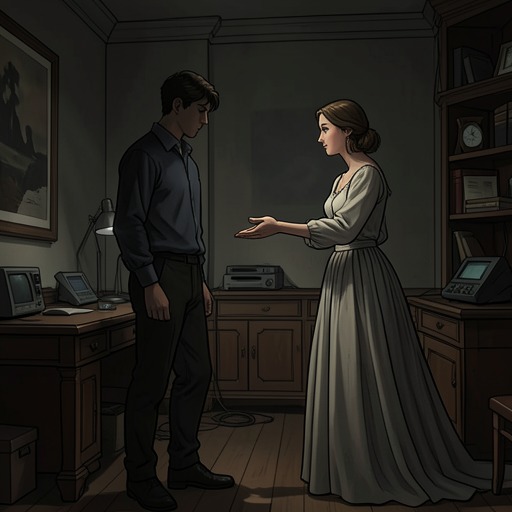
Goblin is identified as an evil ghost attached to Quinn from childhood. The haunting does not end when Quinn undergoes the Dark Trick and joins the Undead. Instead, the presence grows stronger and more hostile, making the change in Quinn’s condition no release from his earlier fear. The narrative also calls Goblin Quinn’s doppelganger, suggesting a disturbing likeness or doubling, though it does not explain the nature of that resemblance.
The haunting has consequences beyond Quinn’s private experience. Goblin causes the death of Quinn’s great-aunt, Aunt Queen, by making the eighty-five-year-old woman fall. Her death turns the ghost from a long-standing torment into a direct danger to the people Quinn loves, and becomes part of the reason that removing it is urgent.
Merrick’s Exorcism
Quinn seeks help from Lestat, who brings Merrick to Blackwood Farm because she had been a scholar and sorceress before becoming a vampire. Lestat believes her learning and supernatural abilities may make her strong enough to end the haunting permanently. Merrick succeeds in solving the riddle of Goblin and carries out the exorcism by building and lighting a high altar of coal and wood.
The rite destroys Goblin’s corpse, but Merrick enters the flames with it. Lestat tries to pull her back; once her soul has departed, pouring his blood over her burned remains cannot revive her. The exorcism therefore resolves the haunting at an irreversible cost: Goblin is gone, and Merrick is gone as well.
Quinn After Goblin
After the exorcism, Lestat tells Father Kevin Mayfair that Goblin is gone from the house and that Quinn is free of him for the first time in his life. Lestat wonders what that freedom will mean for Quinn, a question that places the end of the haunting at the beginning of a new uncertainty rather than presenting it as a simple, uncomplicated victory.
Quinn’s grief over Aunt Queen and Goblin’s disappearance later appear together in Lestat’s account of his feelings for Mona Mayfair. Lestat observes that Quinn’s concern for Mona continues to displace his own sorrows, including the losses of Aunt Queen and his doppelganger. The statement marks Goblin’s continuing importance after the exorcism: although the spirit no longer haunts Quinn, the history of their connection remains part of how others understand his grief and attachments.
Haunting and Release
Goblin’s case becomes a point of reference when another ghost is discussed at Blackwood Farm. Big Ramona recalls that those around Goblin told him he was dead and that he went on, proposing that the same approach be used again. Quinn agrees that he can tell the other spirit to go on, adding that an entire séance may not be necessary. This recollection emphasizes the practical, interpersonal character of the exorcism: ending a haunting requires recognizing the ghost’s condition and addressing it, not merely treating it as an unseen threat.
Goblin’s arc is built around a sharp reversal. A presence that once seemed inseparable from Quinn is finally expelled, yet its departure is bound to death—first Aunt Queen’s, then Merrick’s—and leaves Quinn with grief rather than erasing the past. The spirit’s narrative role is thus both antagonistic and consequential: it threatens Quinn’s family, prompts Merrick’s final act, and makes freedom inseparable from loss.